Hacking the Subway: Public Installation & Data Music Video
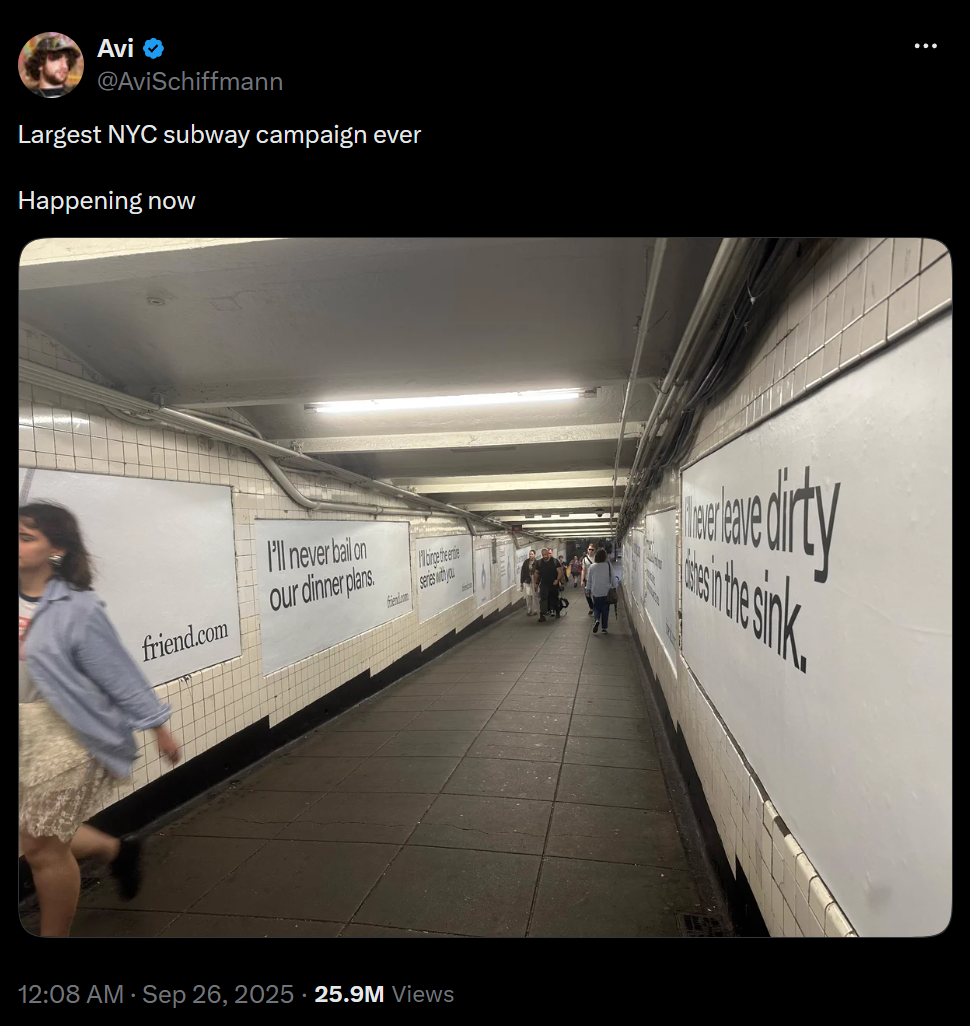
In October ‘25, the New York Times interviewed Avi Schiffmann (Montali 2025), CEO of Friend, a company building a wearable AI companion product. They asked about a stunt in which he littered the New York City subway with provocative ads about his wearable device. On them, in large, bold print, were slogans such as “I’ll never leave dirty dishes in the sink” or “I’ll never bail on our dinner plans,” shown in [ TODO — unresolved image reference "<Img. 1 >" from the source document ]. Shamelessly, he promoted the idea that AI friends are superior to human ones. As intended, New Yorkers fell into his trap, sparking harsh public backlash, elevating his childish stunt to viral acclaim, and landing him the New York Times article he was certainly hoping for.
Many of his ads were soon graffitied over with statements about capitalism and profiting off loneliness, ranging from "Fuck AI" to "Don't let [your] friends sell their souls" to "Human connection is sacred." He seemed to relish the attention, posing for pictures in front of the outcry. He even claimed the intervention was an art exhibit, saying that "The mayor should come and appreciate what we've done." A VC-backed company advertising its product is far from an art exhibit. And as an American artist, I couldn't let that ignorance be the final word.
I first noticed the trend of AI companies leaning into dystopian, provocative campaigns when I was in New York City in '24, with Artisan's “Stop Hiring Humans” slogan (“Why we put "stop hiring humans" on billboards and what it actually means” 2026). Well before Schiffmann, they had their 3-word slogan on billboards towering over citizens in NYC and SF. They further clarify on their website that they only automate the “worst part of cold outbound,” not the entire human role. But they seem to be feeding on fear to drive engagement, intending for their slogan to be misleading, because that is not what “Stop Hiring Humans” suggests.
So when a new MIT initiative, Advancing Humans with AI (AHA), held a contest in my lab to fund ideas to advance its mission of helping humans flourish with AI, I turned this idea on its head. Rather than obnoxiously forcing a future on the public with these campaigns, I proposed using artistic subway ads to gather local voices on what a flourishing future with technology really meant.
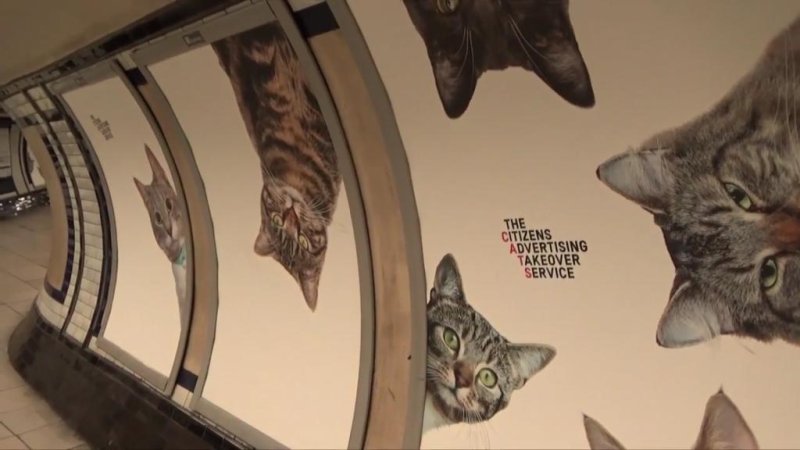
I'd seen a community-funded project called "Cats on Subway Ads" or Citizens Advertising Takeover Service (C.A.T.S.) (“The Citizens Advertising Takeover Service (CATS) by Glimpse — Kickstarter” 2016). This was a crowdfunded campaign that raised £23,131 to replace advertisements at London's Clapham Common Tube station with photos of adoptable felines, reclaiming the space for the public interest. Some cities, like New York City’s MTA Arts and Design Commission, reserve ad space in the subway to showcase local artists' work. This proposal complements the category of reclaiming public space for an artistic intervention, with the output being a poll of local communities' thoughts on AI.
To my surprise, I was awarded a $5,000 grant to purchase subway ads to poll the Boston public on what flourishing means with AI in conjunction with my thesis. Having never run a public campaign before, I reluctantly set out to create promotional posters for my thesis musical and solicit public feedback about our future.
Public Installations and Community Source Data Projects
One of the largest studies of moral preferences regarding AI was conducted by MIT's Moral Machine (Awad et al. 2018). It used a multilingual online game to pose autonomous-vehicle dilemmas and gathered forty million decisions from respondents in 233 countries. It existed strictly as a website, but it was doing what I wanted the After AGI subway installation to do: make a poll that is itself the artwork, staged in public, about our future with AI.
The subway posters were going to reach the Boston community, specifically those on the Red Line. I chose this train route because it runs through Cambridge, from Alewife to Kendall/MIT and Braintree, serving a mix of students, tech employees, and everyday Bostonians [ TODO — unresolved image reference "<image >" from the source document ]. I intended to keep the survey anonymous to encourage honesty from passengers and to get as many responses as possible.
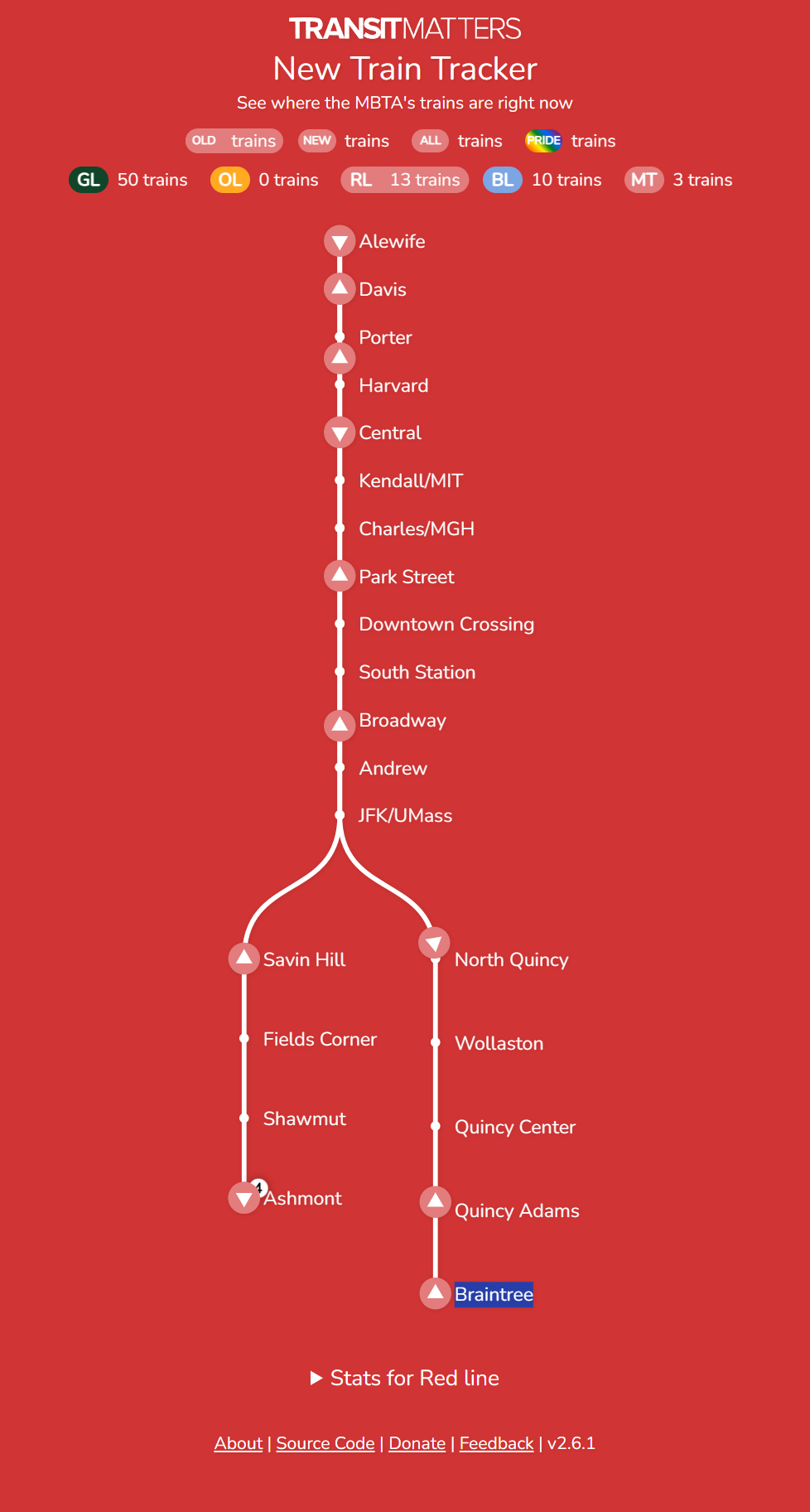
Img. 09 —Screenshot of the redline route taken from the TrainTracker | Site: https://traintracker.transitmatters.org/?line=Red
I planned to integrate subway passengers' responses into the musical, crafting an emotional experience from this data rather than framing it as a research argument about how AI should be regulated. Anthropic interviewed 81,000 people about their perspectives on AI in December '25, publishing the analysis the following March (“What 81,000 people want from AI” 2026). It offered what looked like an objective overview of public opinion about the company's own product. I knew I couldn't reach anywhere near that many people, but I also couldn't ignore the conflict of interest Anthropic had in shaping this narrative. So instead of competing with their analysis, I went the other way, creating an emotional record of what people were actually feeling about a fraught subject.
I took inspiration from other artists who have used polling in their work, such as Hans Haacke, who placed two transparent Plexiglas ballot boxes in the Museum of Modern Art for MoMA Poll (“MoMA Poll” 2015). Visitors were asked whether Governor Rockefeller's silence on Nixon's Indochina policy would cost him their vote. This question aimed directly at the museum's own board. 37,129 people dropped a ballot, more than two to one against Rockefeller, and the piece established that a poll could be the artwork, and an aesthetic object could be accumulating public opinions.
Candy Chang's Before I Die (“Before I Die” 2021), carried that gesture entirely out of the institution. A stenciled prompt, "Before I die I want to _______", on the chalkboard wall of an abandoned New Orleans house invited anyone passing to answer; this format has since been replicated on over 5,000 walls in more than 75 countries. What Chang demonstrated is the mechanism this project depended on: a well-crafted prompt in public space that would actually encourage people to scan a QR code and respond.
Similarly, Rafael Lozano-Hemmer's Open Air (“OPEN AIR” 2012) let Philadelphians submit thirty-second voice messages through a mobile app, which were then played back, underscoring the movement of twenty-four robotic searchlights along the Benjamin Franklin Parkway. He received nearly six thousand messages and created the largest crowd-sourced public artwork the city had seen. I liked that the reward for participation was visibility; you see your answer become part of a public experience. Therefore, what I hoped to achieve was a final artwork where, if you participate, you see yourself inside the result.
Designing the Intervention
The posters needed to be bold, artistic, and a bit flashy if anyone was going to fill out the survey. Subway cars are often overcrowded, with dysfunctional air conditioning, ringing with the jarring squeal of steel on the track. So I predicted that catching the attention of riders locked into their phones wouldn't be easy. I just didn't know how hard it would be.
Unlike Schiffmann, who had a million dollars to burn, my $5,000 budget bought 8 half-car spreads. This meant my ads would take up one entire side of 8 subway cars. This was the most immersive quality I could achieve within my budget. That was the most immersive result I could get for the money: four horizontal panels running around the train windows above passengers' heads, as seen in Img. ##, plus two larger square posters flanking the sliding doors, facing anyone stepping off.
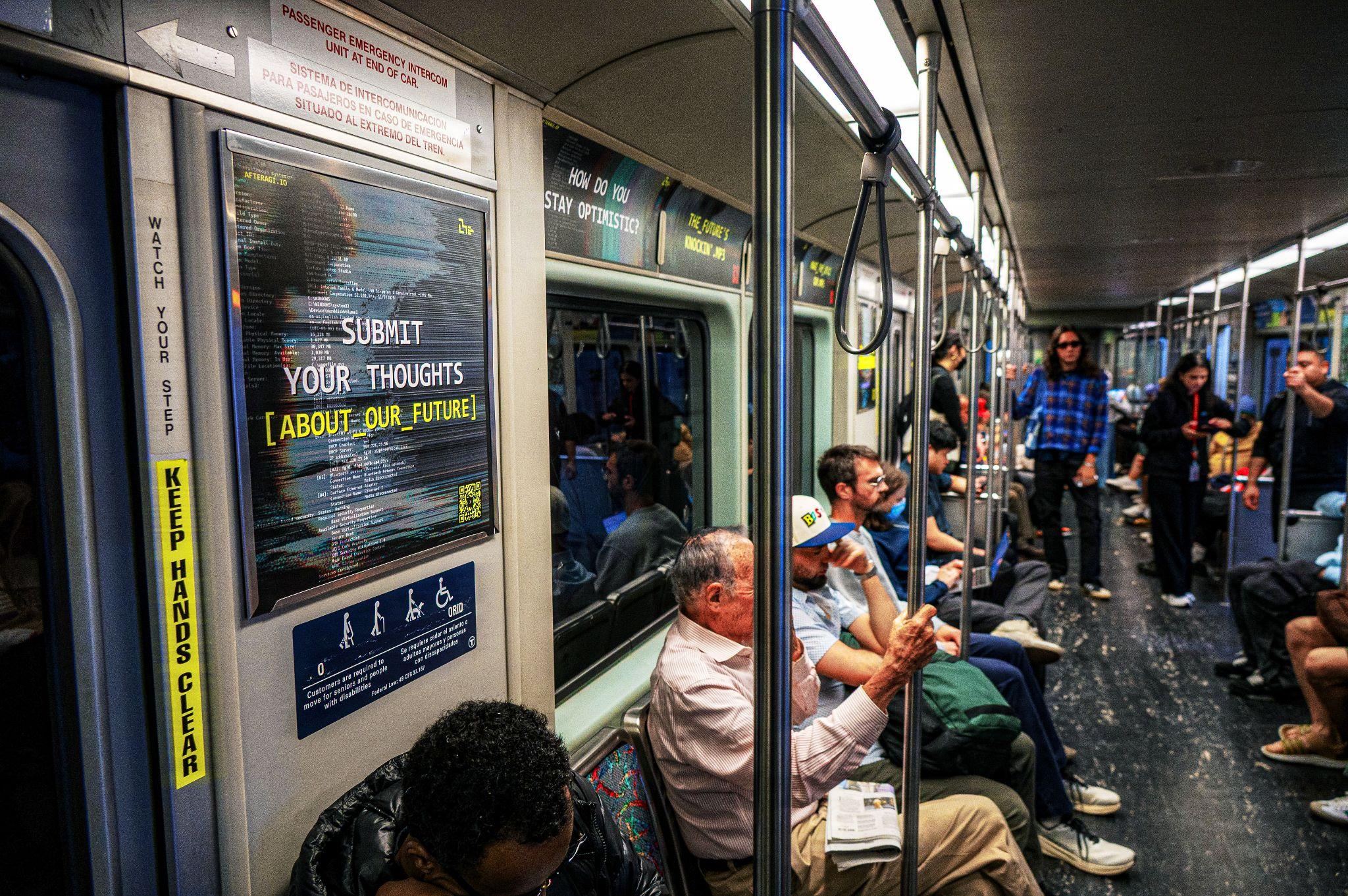
For the design, I leaned into the glitch aesthetic I had been crafting for the digital world built on afteragi.io. I created a sheared gray, glitchy backdrop that streaked across the train car from end to end, shown in image ##, giving the environment an immersive feel. The text printed on each of the long posters above the car’s seats were song titles from the After AGI musical, including “Make the Devil Cry” and “The Future’s Knocking.” Additional survey questions also hung above the passengers' heads, such as “How do you stay optimistic?” and “Who should control Superintelligence?”
These were designed to stimulate curiosity about the project and prompt them to scan the QR codes placed in the corner of each poster. This QR code led people to a short online survey where I could collect data on riders’ perspectives. The largest posters, which flanked the car doors, stated: “Submit your thoughts about our future,” and the musical title: “After AGI: The Techno-Apocalypse Musical”
It wasn’t until I purchased these ads that I fully appreciated how many QR codes are in a subway car. Nor had I fully grasped that out of all the QR codes I’d seen in the past, I couldn't recall scanning any. After I got confirmation that my ads had been hung, I struggled to track my 8 subway cars among the nearly 100 in service each day. Thankfully, an attendant kindly directed me to the city's train tracker app, which gave real-time location data of each car. The sophistication of this system surprised me, but I was finally able to catch them.
Upon arrival, I was ecstatic. The style was bold and artistic, exactly as intended. It felt like the musical had permeated the real world. But I doubted anyone would fill out the survey at all. The voices of my peers rang in my head: "I don't want to get hacked! I never scan QR codes." While I took a moment to photograph the posters proudly on display, I kept thinking about how they'd only be up for a month. Silently, I prayed that a few trusting people would see them and feel what I felt, excited enough to play along.
For the survey, I created 10 questions that targeted the public perception of AI's impact on society. After scanning the QR code, subway passengers first consented to their data being collected, and then were prompted to answer a set of 5 questions. This was designed to increase the likelihood that a rider would complete the survey by requiring them to answer only 5 of the 10 questions. However, if a rider did not finish, their partial survey submission was still recorded.
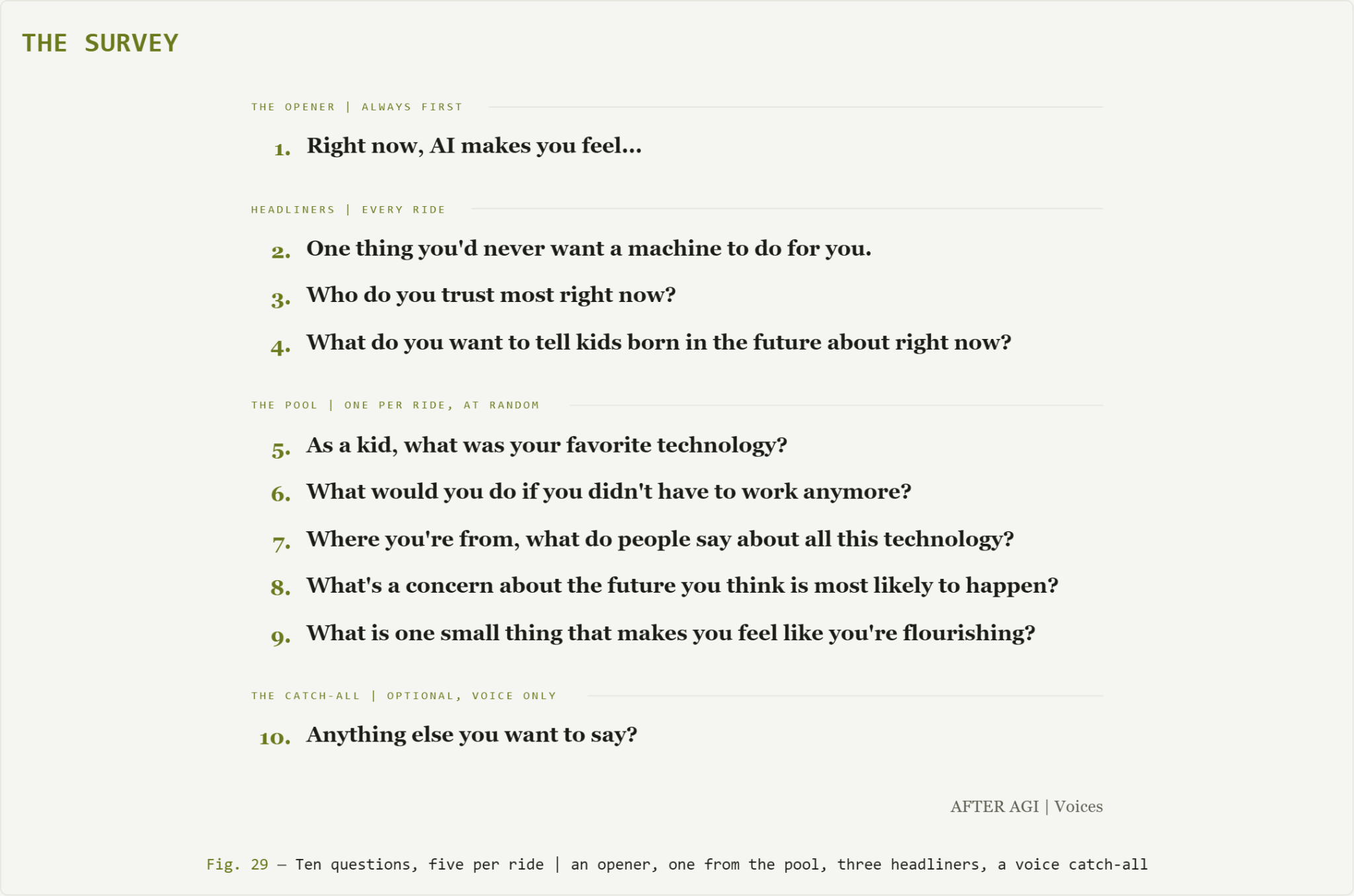
All 10 survey questions are shown in Figure 11. It always begins with the question: “Right now, AI makes you feel...,” followed by 4 short responses and a catch-all 6th question, “Anything else you want to say?”, which was optional. Riders who completed the survey could also voluntarily share their email addresses so I could forward them the final musical experience I created, which they contributed to. The questions were intentionally neutral in tone to gather both positive and negative responses.
Between mid-May and mid-July, 167 riders filled out the survey. I am still collecting responses, and anyone can fill it out at the link: afteragi.io/voices. The answers of the 167 subway riders to the first multiple-choice question are shown in Figure 12. Riders could also submit short responses or type their own descriptions, as shown in the bottom half of this figure.
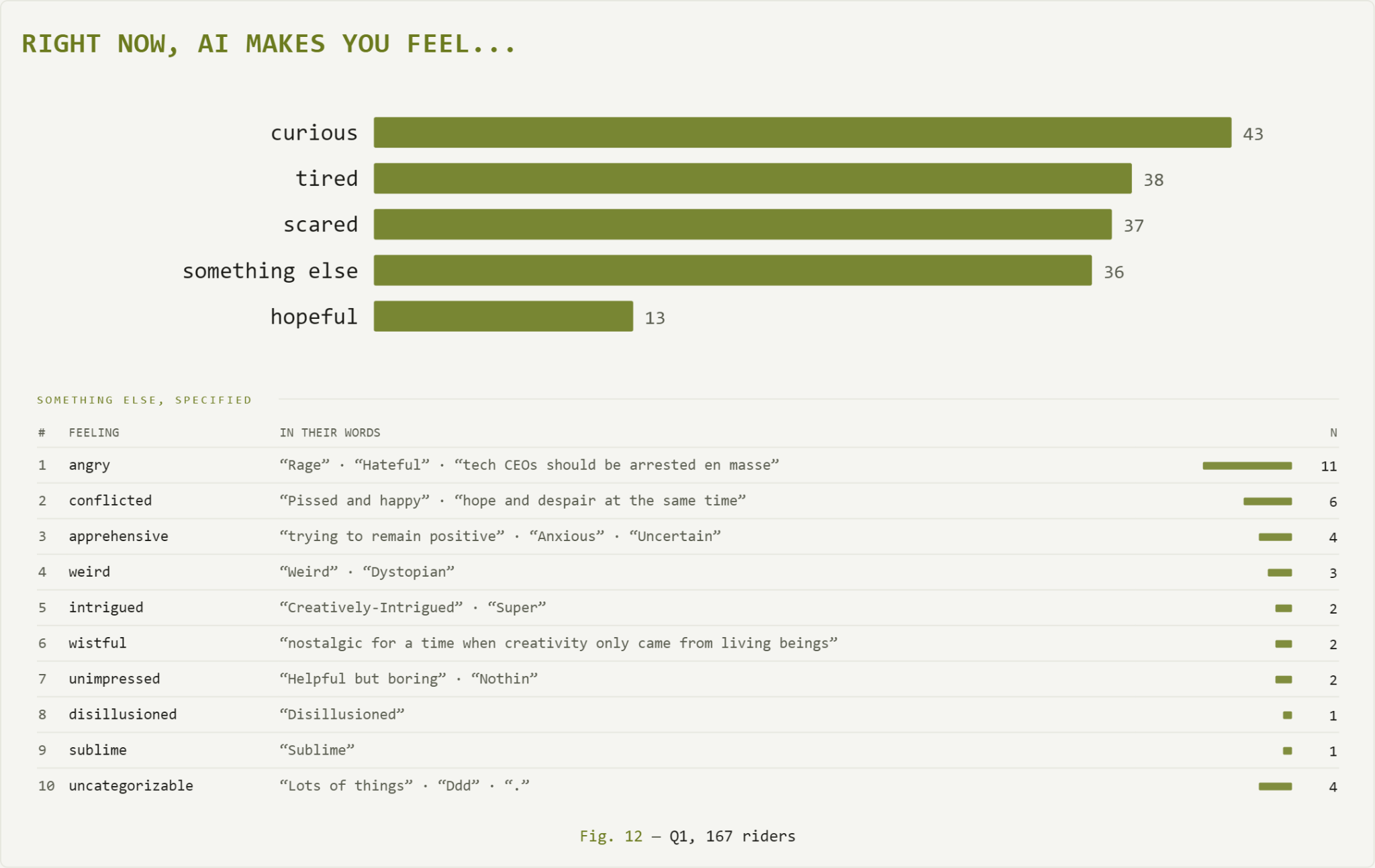
Figure 13 shows the time of day at which all passengers completed the survey. As expected, responses peak at peak commuting hours around 5:00 pm or 17:00 hours, with a dead period when the subway stops running between 1:00-5:00 am.
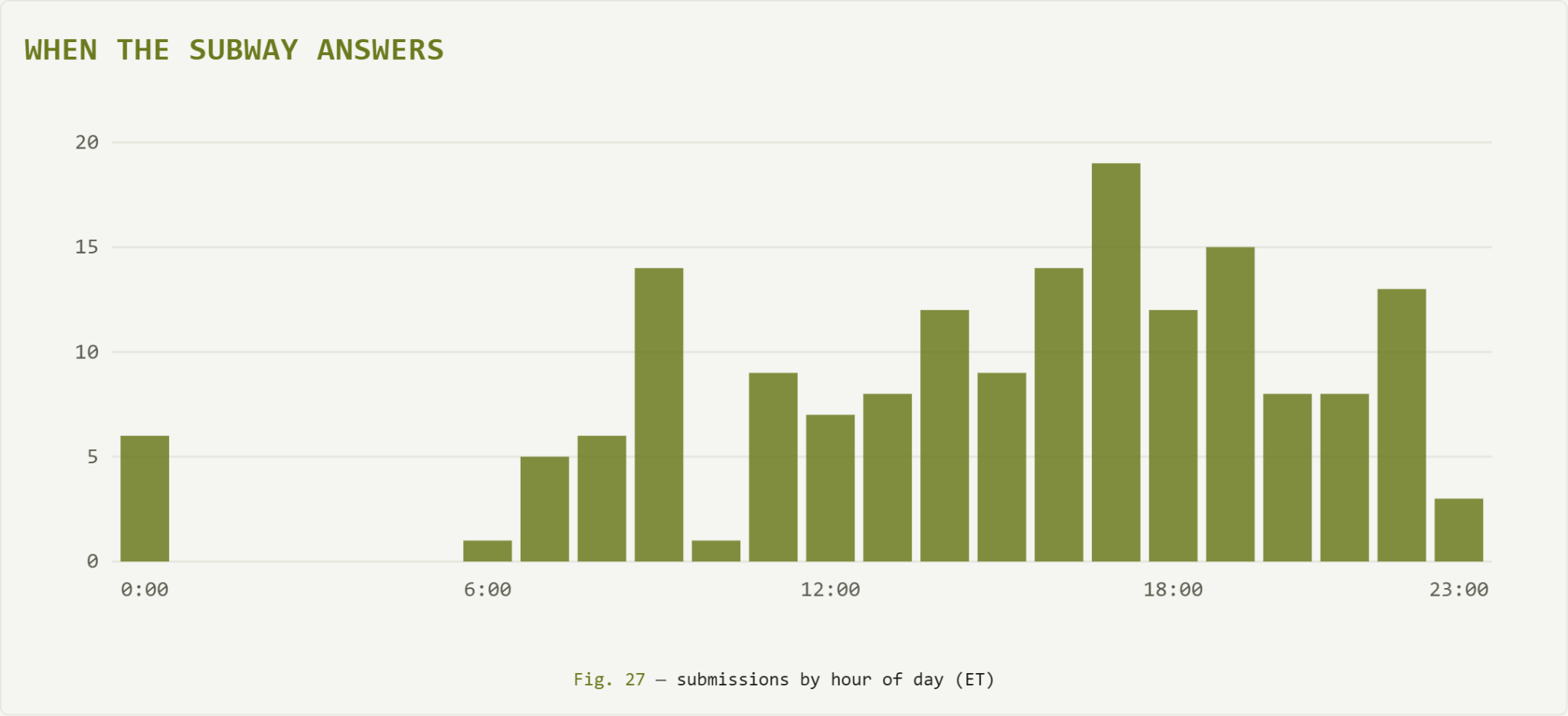
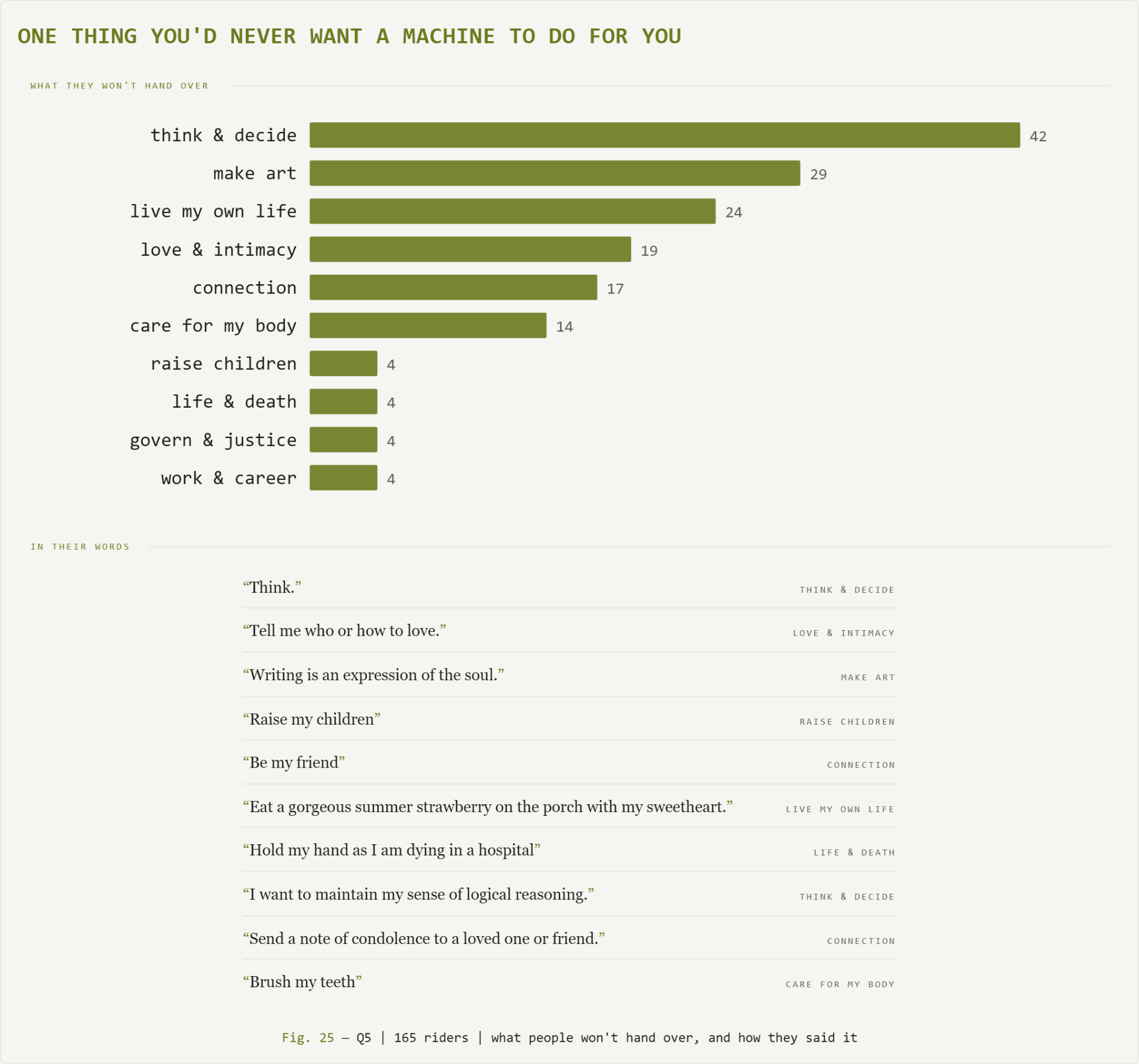
Figure 14 shows how responses varied across the survey. Asked "What's one thing you'd never want a machine to do for you?", responses grouped into categories: think and decide, make art, live, love and intimacy, connection, care for my body, raise children, life and death, governance and justice, and work and career. Most wrote about cognitive replacement; 42 fell into that category. One wrote, "I want to maintain my sense of logical reasoning."
Many were concerned about AI eroding the sacredness of art; 29 fell into this category, with one rider saying, “writing is an expression of the soul.” There was a surprisingly small amount concerned with job replacement, with only 4 in this group responding, “My job,” “My Career :(“, “My job.”, and “Take over entry level jobs.”
P8: Always cite the Models you use
Hacking the Subway was in production alongside the musical itself, which was set to premiere on May 4th. I didn't receive the funding until January '26, and didn't confirm the purchase of 8 half-car spreads until late March. My release date for this campaign was set to run on May 17th, which I thought would still catch students in Cambridge during graduation. I was developing this while running behind in finishing the musical. Needless to say, I was tight on time.
I used Midjourney to mock up the background textures for the posters, which I edited in Photoshop, adding FX, text, and shaping them to the specified dimensions required by Outfront, the ad agency. These Midjourney backdrops were meant to be placeholders, but I ended up using these images in the final versions shown in Image 10. Below is the prompt I used in Midjourney for making these. I ran through about a hundred versions before settling on the ones hung in the cars, which had significant alterations done in Photoshop.
Text prompt: Abstract glitched composition with horizontal lines and pixelation, creating a data error effect. The color palette includes dark grays and blues, punctuated by vibrant horizontal bands and irregular shapes of orange, yellow, green, and light blue. The central area shows a wave-like distortion with bands of color bending and stretching, suggesting movement and a liquid-like quality, against a background of fine horizontal scanlines.
Rather than opening the debate about the ethics of using an Image model AI in this section, I summarized this point as a simple, important rule: Always Cite the Models You Use. Specifically, I used: Midjourney v8.1 Standard. I believe public opinion about the use of AI will continue to evolve as it becomes so commonplace we forget we are using it. And it seems like we are moving into a direction where AI will have ingested all of our creative outputs in some capacity. Regardless, it is the proper ethical practice to cite all the models you use in a project.
I trust you to make a judgment about the ethics of how you use AI and the data it relies on. There are many ongoing copyright lawsuits against AI companies from independent artists to large corporations. Where you draw the ethical line in your work, I believe, is for you to decide. I don't mean to patronize you with this rule. But it is important people know what models you use to give appropriate credit and context for your work. Noting which version of a model you used is also important for archival purposes, since these models change so rapidly.
P7: Learn the tools of the craft, but try building your own tools
Google Forms and countless other apps already exist for capturing survey responses. But I love this principle titled: Learn the tools of the craft, but try building your own tools. I'm serious! Why not build your own survey tool? Maybe your own FX plug-in for your favorite DAW for making music. Or train your own ML model to create images unique to your style rather than using Midjourney. If I had more time, this is what I would have done. Although I did build a custom survey app to sort the data as needed and interact with subway passengers as intended.
AI is great for helping you build your own custom tools rather than relying on what's available in the marketplace. That is one of the best parts about AI. It can augment your abilities to achieve feats that might not feel possible on your own. I understand if it feels daunting, and it certainly is not as easy as using whatever already exists. But AI does allow you to build at an incredibly accelerated pace, making larger-scale tasks more achievable. And the benefits of making your own tools include adding features tailored to your project needs that a general-purpose tool can't meet. You'll also understand your audience yourself, instead of trusting a third party's system for providing what they need. Building tools to meet your personal needs is something I encourage you to explore, because making a new tool for yourself is a creative act in itself.
All the while, if you are new to a field, it is immensely advantageous to learn the tools of that craft. This helps you gain a deeper appreciation of the domain you are entering. For example, I taught myself to use Ableton as discussed in Chapter 02 and used AI along the way. If you skip this step, you will miss out on foundational knowledge necessary to make high-quality work.
Learning a new field is an uphill battle, but learning the tools of the craft is the entry point. They give you a direct sense of how professional work is done in a field. Additionally, your ability to use them can indicate your overall skill and may be an important indicator of how much you have improved on your journey.
Public Data Music Video
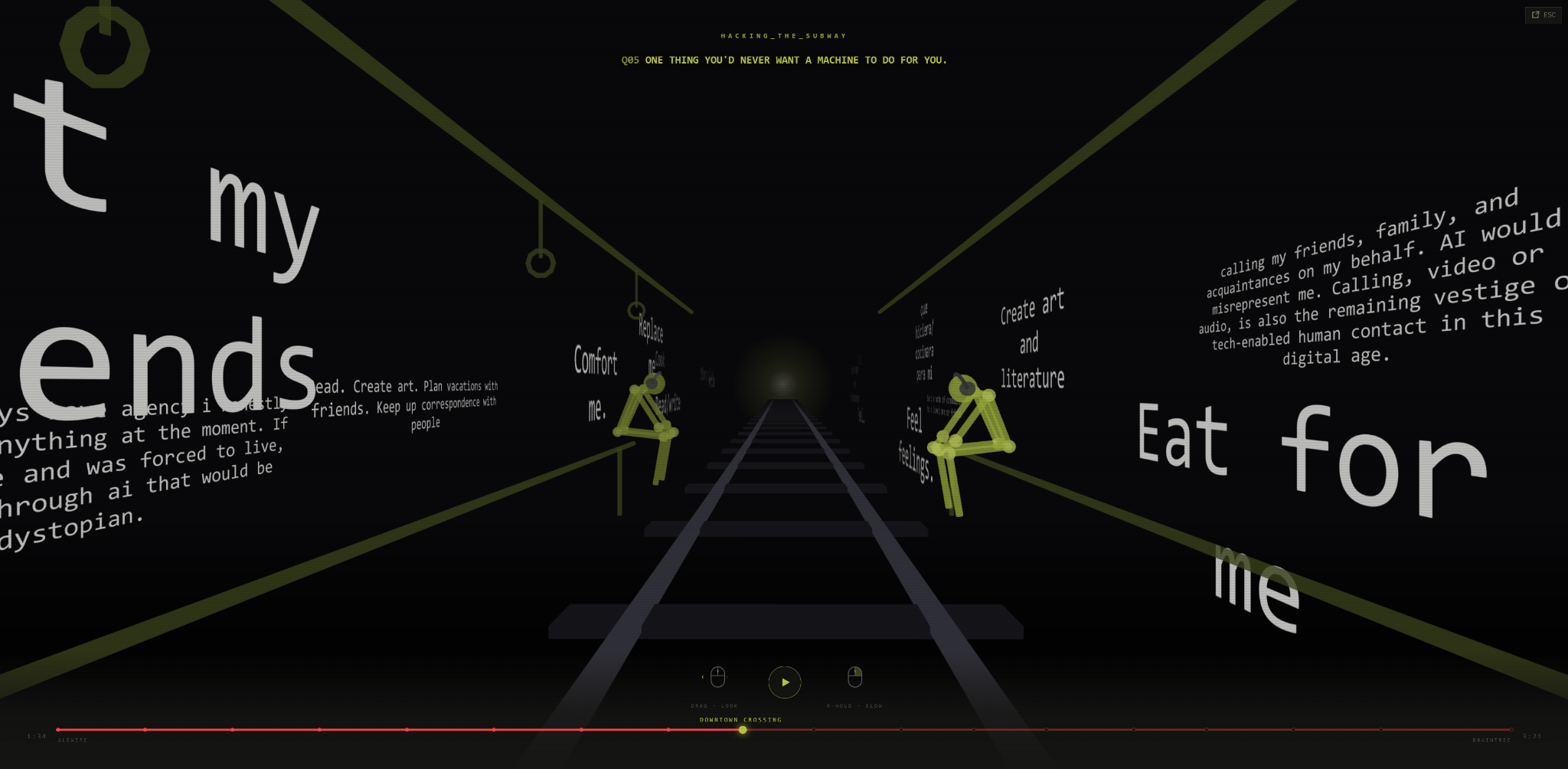
All the responses gathered across the subway campaign can be experienced in the data music video at afteragi.io/subway.
The boarding sequence begins by placing you in a 3D scan. I caught the last 1 a.m. train, waited until all passengers had left the car, and then used my phone to capture images of it from inside. Using photogrammetry, I reconstructed the subway car and Kendall Station in 3D from these photos.
Photogrammetry is a machine's way of seeing: it rebuilds a space by triangulating the points that overlapping photographs share. Where the photographs can't agree on glass, on steel, on anything too smooth or with too little data, the reconstruction fails, and the geometry tears, stretches, and melts. I exaggerated those failures.
The reconstruction comes out jagged and half-resolved, the space as the software could recreate it, not as the eye would see it. With this, I developed a navigable yet immersive experience of the Kendall Station subway platform, leaning into the digitally jagged 3D style of these imperfect scans. Scrolling through the Kendall Station online puts you into a digital twin, so you feel as if you're inside it, a ghostly simulation of the real platform.
Pressing play lets you board the Red Line train, which is timed to the song "Fighting for Hope" from the After AGI musical. This song was created to underscore the public data music video. At the very beginning, you are placed in a moving train at the first stop, Alewife. As the music video plays, we travel along the Red Line's path, passing each station as we watch the riders' survey responses pass us by. All 10 questions are pinned to different points in the song, and by the time we reach Braintree, completing the Red Line's path, you will have seen a subset of all responses to those questions.
To make the experience smooth and fresh on each ride, the rendered responses are limited to 100 per question. This makes more of the text legible and reduces the load on your browser, providing a smooth experience on any laptop, desktop, or cellphone. The 100 responses are randomly chosen each time you ride the public data music video. With 167 submissions in counting, you are likely to see new text on each ride. You can submit your answers to the questions to be added to the public data music video at afteragi.io/voices