Making a Musical: The Music
Unknown to me, the first set of rough-draft tracks created in July '25 was all set to the default DAW tempo of 120 beats per minute. That's the BPM Ableton gives you when you open a new project. I had no idea you could change it.
Little did I know that the most important thing about learning to make music would have nothing to do with technology at all. It was learning to listen. Looking back over my year of using AI to help me learn to make music, I was reminded of Pauline Oliveros. I'd studied Oliveros, a pioneer in electronic music, and was familiar with her emphasis on “Deep Listening” (Oliveros 2005). I'd even participated in her sonic meditations [cite], in which she curated instructions to help you learn to listen rather than just hear. But it was not until I began to make music that I opened the door to what she meant.
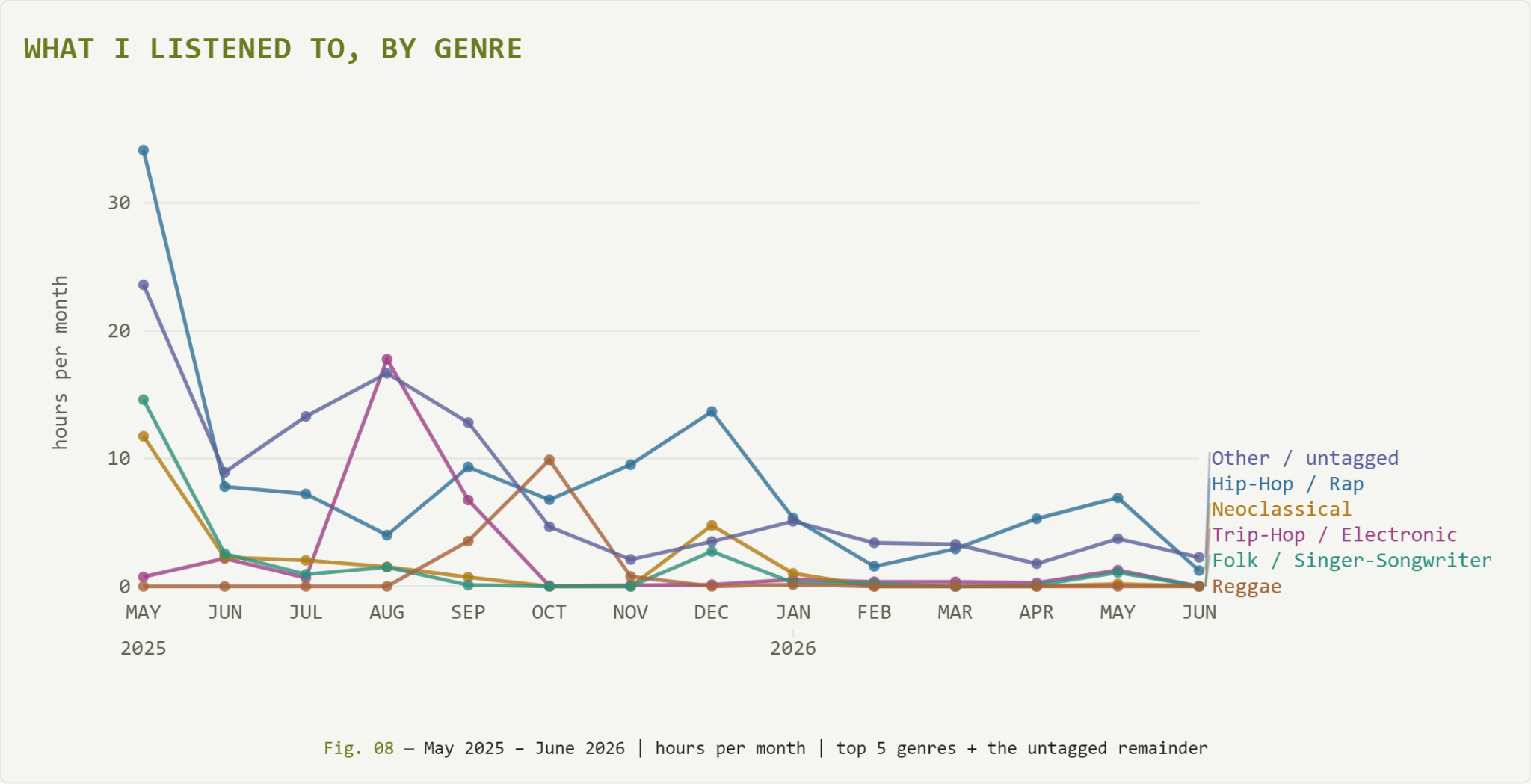
During this process, I listened to 314.9 hours of music and played 16,648 tracks by 1,148 different artists. I also wrote over 160 songs from scratch, with no samples. The top genres I listened to while making all of this music are shown in hours per month in Figure 7. With a background in dance & filmmaking, I was familiar with searching through all genres of music and curating playlists for projects. But making an original soundtrack was an entirely different hurdle.
What I ended up doing was training my ear to be as attentive as a surgeon's eye upon opening a body on the operating table. For each song I listened to, I wanted to hear each element. The kind of hi-hats, the loudness of the snare drum, the density of notes in the lead guitar or lead synth line. I would count how many instruments were in a song. This was necessary because, at the start, I was completely clueless.
Using AI to Learn Music, not Generate it
Learning to make music was easily the most difficult, emotionally draining, and time-consuming part of this project. No tracks, stems, or melodic lines in this work were AI-generated. Everything was written from scratch. Documenting how I used AI to learn music made theoretical sense for a thesis. What I hadn't understood was the psychological stress of having to share music I had only just learned how to make.
To meet the deadline of a first draft of songs by August 31, I began with the instruments I had: a guitar and a MIDI keyboard. The MIDI keyboard I had been dragging around for years after a spur-of-the-moment purchase in 2020, intending to learn to score my films. The task seemed so daunting, I never started. The guitar, which I purchased as a birthday gift to myself in preparation for this project, seemed like an easier place to start. I asked Claude how to learn guitar. It directed me to justinguitar.com.
By watching these free lessons on YouTube, I learned the basics of chord progressions while writing the first draft of the script. But as I wrote the first draft, it became apparent that the guitar's sound had no place in this project. I needed to be making techno music. So I pivoted to the keyboard and purchased Ableton, a DAW (digital audio workstation) for creating music on your computer.
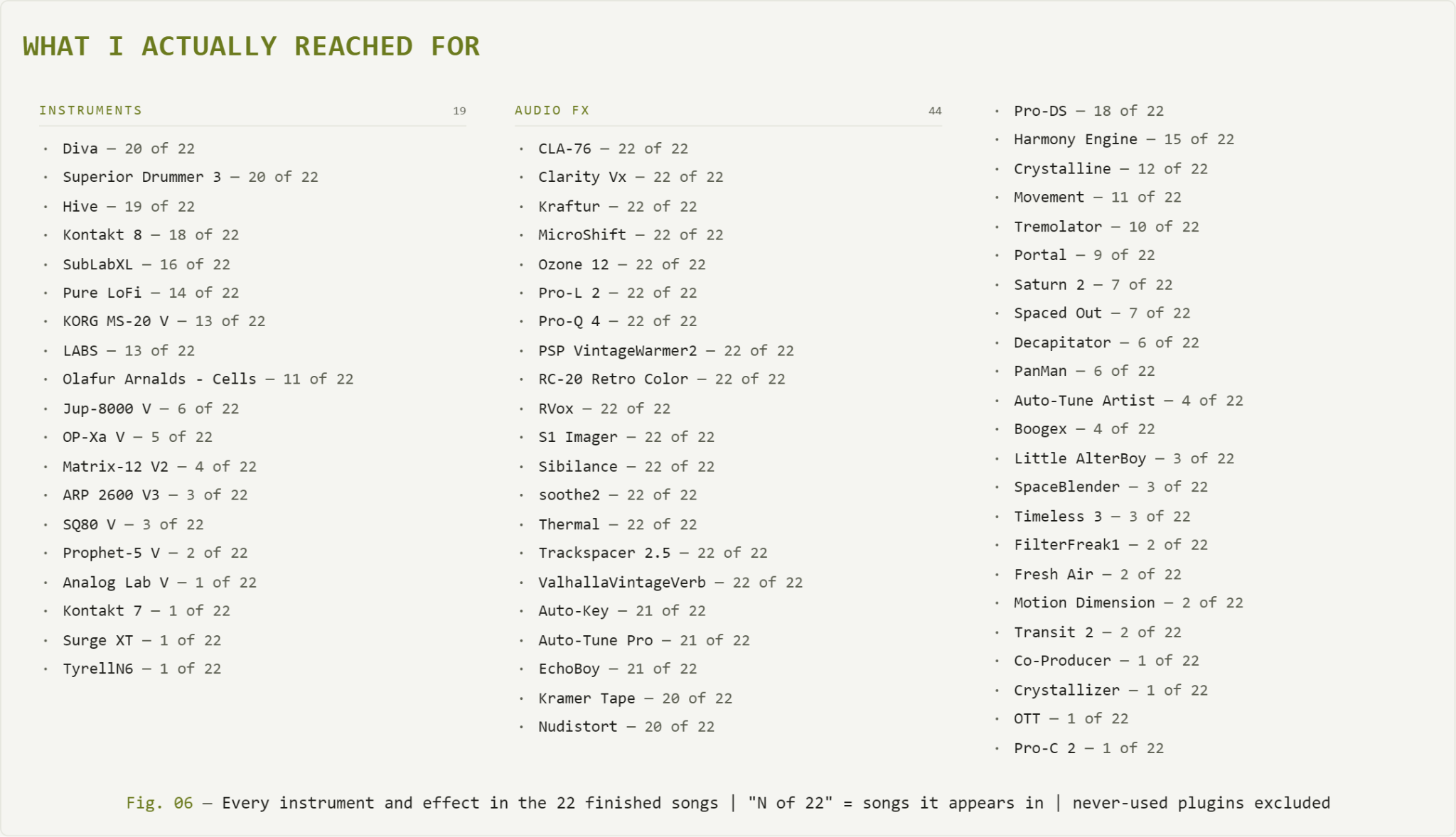
This is where AI became the most useful, not in the chord progressions, but in learning how to use Ableton. This was a steep learning curve, but not impossible. Over the next 3 months, I learned the basics of producing music, specifically techno music. This included what an LFO was, a fader, ducking, EQing, mastering, and mixing. AI was useful in deciding which plug-ins were necessary to achieve the sonic qualities I was looking for. It also helped me decide which instruments would shape my sonic palette. Figure 8 shows the most-used FX and instruments that ended up in my Ableton projects.
During those first three months, my basic knowledge of how to compose a track slowly improved. Still, I was utterly ignorant of how far I still had to go. My notes strayed from the measure lines, making their own unpredictable paths. The imbalance in levels on my masters made any vocals inaudible. Choosing presets on my first synths, I didn't understand what the category "lead" meant — a lead is simply the instrument playing the main melody. There were countless things like this, things I didn't know enough about even to ask AI the right questions to learn more. I learned the old-fashioned way: trial and error.
Sporadically, it would occur to me to dissect the details. Those details became increasingly complex, from finally learning how to change the BPM of each song and quantizing notes so they stayed in time, to how to EQ a vocal reverb to give the voice an airy quality without making it sound muddy. I felt my mind growing into the crevices of building a real piece of music. But as I got deeper into developing how I wanted to compose, AI became more efficient for answering my questions, but it became clear that it was useless to me for making the music.
As my knowledge hit a tipping point, I opened up a truly infinite world of musical possibilities I could create without AI at all! More importantly, I felt that the songs I created, piece by piece, sounded vastly more interesting to me than anything I generated using AI. Mainly because my music always sounded so much weirder. Working directly with the virtual instruments, I could craft the sounds I wanted together, and improvise the melodic lines I heard in my head. So it always felt more personal too.
Learning to Listen
Listening to music, I found, was a critical skill I needed to develop. Playing random chord progressions on my keyboard wasn't going to cut it. I needed to analyze the best music to understand how these songs were built. Occasionally, I asked Claude for music recommendations in different genres and attempted to discuss songs. But with AI’s limited ability to analyze audio files, it was no better than a Google search in helping me understand how artists actually created their work. I needed to listen to tracks on repeat and dissect them myself.
Figure 9 is an overview of the most listened-to album during this process. Three albums stood out as influential as I developed the style I aimed to achieve for this project: Exodus by Bob Marley, Mezzanine by Massive Attack, and Circles by Mac Miller.
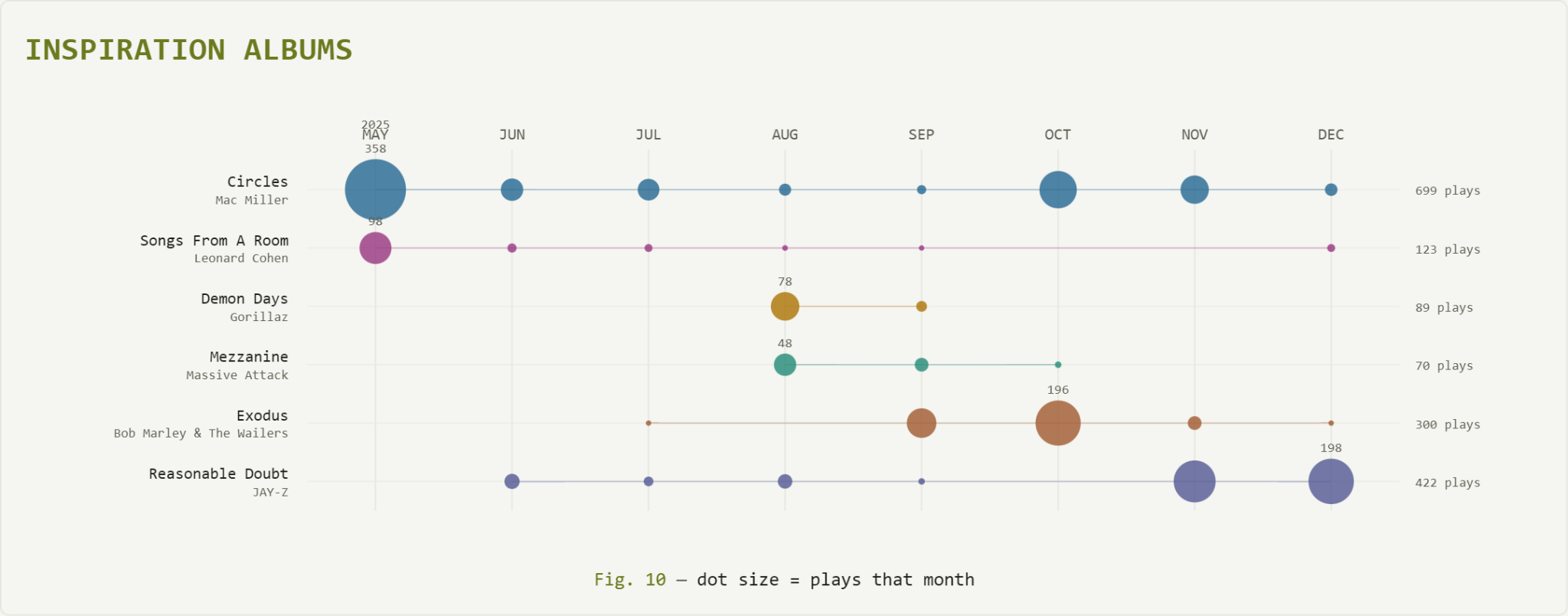
These albums helped shape some of the sonic qualities I aimed to achieve for this techno-apocalypse musical. But in November, I was still far from being capable of making the style of music I aimed for. I'd only just begun, and I needed to improve rapidly to make the music I was hearing in my head. So I decided I needed to practice every day.
I created a playlist of all the music that inspired me for this project's score, then set the goal of making a new track every day to improve as fast as I could. If I made 200 tracks, I thought maybe a couple would be decent. And if I picked the best tracks from this long list for my final piece, I had a slim chance of not being completely embarrassed when I had to perform this work for my entire Lab.
P3: Treat yourself like a generative algorithm.
For 3 months out of this year, September, January, and May, I tried to maintain a routine of making one song every morning. I didn’t always succeed, but I did finish over 160 tracks this year. Many were terrible. Some were incomplete. Not all had vocals, but over 50 percent did. This inspired my next principle: Treat yourself like a generative algorithm. And I intend to be provocative here.
With this principle, I am not suggesting that our brains and AI work in a similar way. But I have found that when creating music with AI, the output can feel incredibly impersonal. This is one reason I decided to learn to create music on my own instead. The fact that a generative model can create a song from scratch in seconds makes me feel disconnected from the product. But I did find it fascinating that a song can be created so instantly, without overthinking.
So when developing this practice of making a song every morning, a skill I built was making choices, sometimes random choices, and making them sound as good as I could. I would often choose a different BPM for a track at the very beginning, forcing variety in the songs' tempos, then quickly lay down a beat or a lead synth line. Over a couple of hours, I incrementally added instruments and FX, EQing the layers as I slowly built a track.
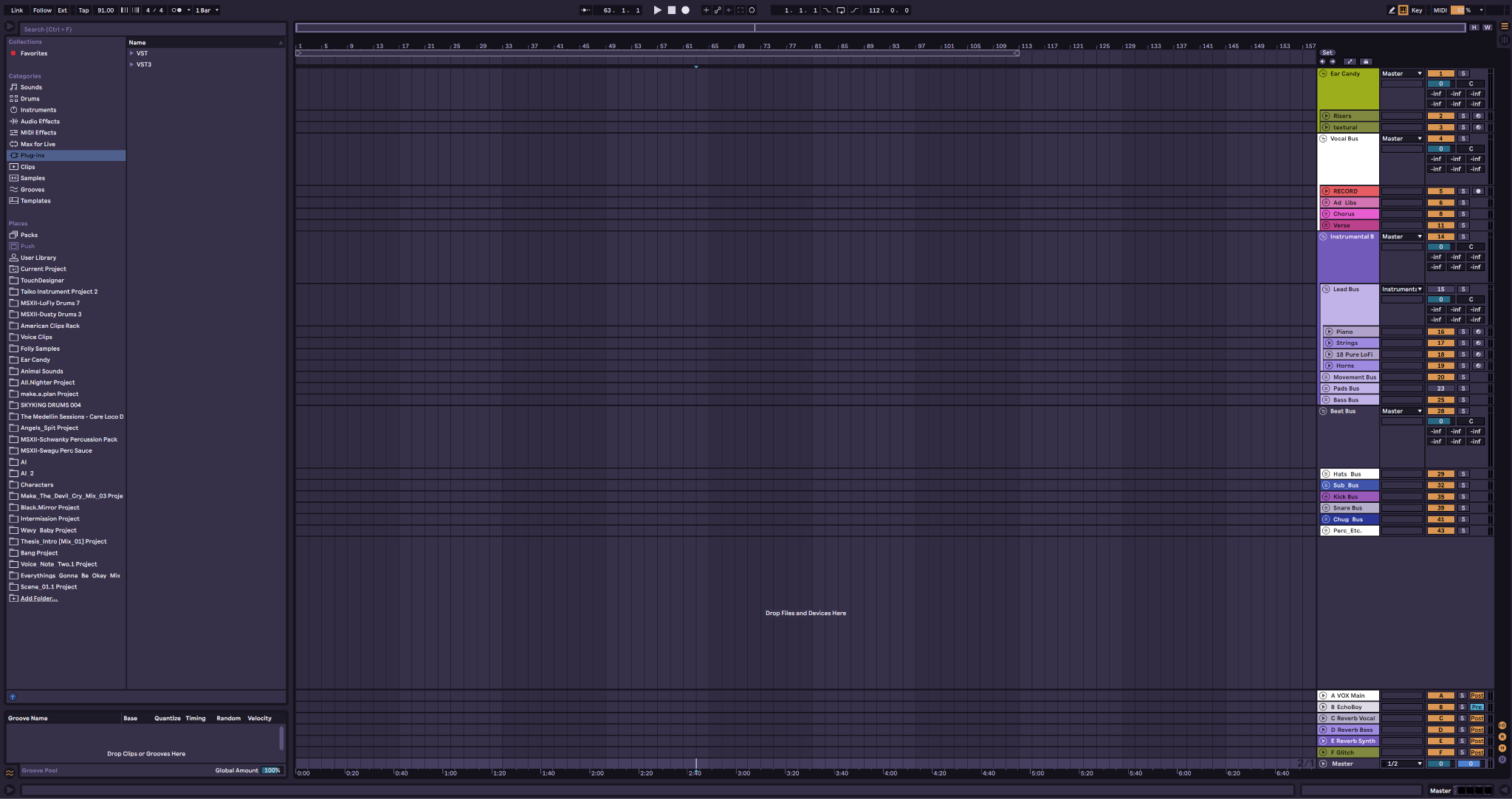
For some tracks I could finish a version I liked within 2 hours; others took most of a day. But most of the time I would finish a track by the end of the day and start fresh the next morning. In this process, I created a template Ableton project with my song layouts, so that every morning I could jump right in. This project template is depicted in the image below.
Making things quickly, with or without AI, produces an enormous amount of insight about your own taste. In my experience, early on I could get quickly attached to a single song. Having an abundance of tracks forced me to feel subjectively and assess objectively why I preferred one over another. That sharpened my style, since I had to choose the best of my own work, and it surfaced a plethora of sounds and elements I would never have otherwise found.
Generative algorithms specifically afford us the ability to create in abundance, producing a surplus of content that might never be used. This often affects our personal connection to what is created. But a beautiful middle ground can be found when you treat yourself like a generative algorithm: creating in abundance, but with intention. Finding this balance, I believe, will be incredibly useful as you shape your style. It is also a method for using AI to your advantage without losing your sense of ownership. Even though I didn't use AI in generating sounds in After AGI, since I developed such a strong practice with this method, I now have a better understanding of where AI might be helpful in my future work.
P8: Novelty is not the metric. Use AI to appreciate the obvious.
More than creating the music tracks, I struggled with writing song lyrics. Having written poetry periodically, I thought this would come more easily. But song lyrics are simultaneously catchy, melodic, rhythmic, poetic, and clear. Plus they need to rhyme. Rhyming has always felt uncomfortably limiting to me, which might be why I didn't get into music earlier. Luckily, my narrative structure gave me clear topics each song needed to address to make the storyline flow.
As with most fields, there are conventions for structuring a song's lyrics. A common structure is: intro, verse, chorus, verse, chorus, bridge, chorus, outro. There is often a reason why things are done the way they are. You don't have to reinvent the wheel. I didn't use AI much in songwriting because it often made my lyrics more generic, but occasionally, to my surprise, the obvious choice was the more impactful one.
When writing, I found myself writing in a style that was too detailed or not detailed enough, making it difficult for a phrase to be realistically sung or rapped, usually because of the BPM of the backing instrumental. For example, this rapped/spoke verse in the song Turing's Rollin’ In His Grave:
I gave this shit my everything, my twenties, and my ambition I thought we were building toward a higher human condition But it turns out capital doesn’t give a damn about your mission It just uses you like a tool, and then it scales the division
Each line was originally too short to fill the space the beat required, so in rewriting it I would add details; in other instances I needed to trim them. Occasionally, AI was better at this process, altering my lyrics by choosing a more obvious word choice or rhyming pattern that I myself would have avoided. I tend to fear spoonfeeding an audience, making ideas too obvious; afraid they might feel insulted. But a few times AI changed my lyric for the better, making the pacing smoother and ideas clearer. This is one example:
Original:
I gave this shit my everything, my twenties, and my ambition I thought we were building toward a higher human condition But it turns out capital doesn’t give a damn about your mission It just uses you like a tool, and then it scales the division
Altered:
I gave this shit my everything, my twenties, and my ambition I thought we were building toward a higher human condition But it turns out capital doesn’t give a damn about your mission It just uses you like a tool, and then it scales the division
Songwriting is one area I am still greatly acclimating to and developing my style for. This is one of the weaker areas of this work, but through working with AI I am learning to appreciate the obvious in this domain. This principle: Novelty is not the metric. Use AI to appreciate the obvious leverages exactly what these algorithms are designed to do: generate predictable results.
Writing is an intimate emotional process. Your style can be intentionally abstract, direct, or quirky. AI can be useful in showing you what people expect you to say. This is important because I often try to reach for novelty, but novelty can be the wrong orienting force and lead you to things many people don't care about. Appreciating the obvious answers can put you in touch with what might be most human, an unconscious part of ourselves that comes so intuitively we neglect it. You might think it's ironic to use AI to help us connect with these subconscious aspects of ourselves. But they have seen more of what people write than any person could read. That is not the same as understanding us, but they know us in ways we can’t fully comprehend.
Not all struggles can be automated.
Not only did I struggle with writing lyrics, but listening to myself sing was pretty terrible when I started. There was no way around this. No computer could make this feel better. Sure, I used Auto-tune. And it helped. But it still sucked to hear myself sing.
I never wanted to be a singer. When I began this musical, I was so focused on making the musical tracks that I failed to realize how vulnerable it would feel to sing over them. This project put me in a position where I had no choice. Sure, I could have used a synthetic voice, but it would have been so untrue to the heart of this project. So I sucked it up.
Listening back to these tracks now, I hear myself more objectively and recognize that I have a long way to go in improving my singing performance. And now, after making all these tracks, I’m excited to take this more seriously, giving it more time to mature. Learning to produce music in a year just wasn’t enough time for me to fully develop my artistry in this domain. But I am grateful that this project challenged me to begin this journey. And I hope to one day call myself a musician with sincerity and integrity.